
What Is Textured Wall Art?
Textured Wall Art is wall-hung work whose surface has real height—knife ridges, built paste, plaster-like grounds—so light can travel across it. A flat print of roughness is not textured wall art. It is a picture of texture. The category exists because a living-room wall is not a screen: afternoon sun, a lamp at the side, and the walk from the doorway all change what you see if the paint actually stands up.
Canvashi’s textured collection is hand-painted 3D canvas made to order: seaside fields, earth slabs, white relief, teal-green grounds, gold on gray. The listing is a language sample. The object you receive should still throw a small shadow when a window sits off-axis.
Texture in art, then texture on a wall
Wikipedia’s page on texture in the visual arts splits the idea in two. Actual texture is physical: fur, sand, raised paint, cracked ground—something you could feel. Visual texture is the illusion of that surface, drawn or printed so it looks rough while remaining flat. Textured wall art, as a buying term, should mean the first kind mounted for a room. The second kind is graphic design on cloth.
Tate’s glossary on impasto is the museum name for actual texture in paint: an area of thick paint. Venetian painters used it; modern painters treated the surface as a subject, not only as a window. A sofa-wall canvas does not need Auerbach’s extreme paste. It needs the same honesty. If the shop says textured, the skin should occupy air.
When the paste is built high enough that the object starts to read as a shallow sculpture, you are next to relief: forms raised from a flat base. Most 3D textured canvas sits between painting and relief. It still hangs like a painting. It no longer behaves like a poster.
Abstract art does not copy visual reality; it works through shape, color, form, and gesture. That is why so much textured wall art is abstract. The subject is often the handling itself. A hint of sea or land can remain. A caption should not be required for the wall to work.
What “3D textured canvas” actually is
3D textured canvas is a marketing phrase for handmade canvas with built medium. Typical layers:
- a primed cloth on a stretcher
- modeling paste, plaster-like compound, or heavy acrylic body
- color stained, brushed, or knifed over the peaks and valleys
- sometimes leaf or a dry-brush scumble on the ridges
It is not a digitally printed “3D effect.” It is not a resin sculpture. Depth is usually millimeters to a short centimeter, not a box that leaves the wall. If a product photo is only straight-on and shadowless, assume the third dimension is in the file until you see an angle.
Plaster wall art overlaps this category when the ground is plaster or a plaster substitute, then painted. True plaster can be heavier and more brittle than acrylic paste. Ask what the ridge is made of if the piece must ship rolled. High plaster often wants stretching before travel, or a crate.
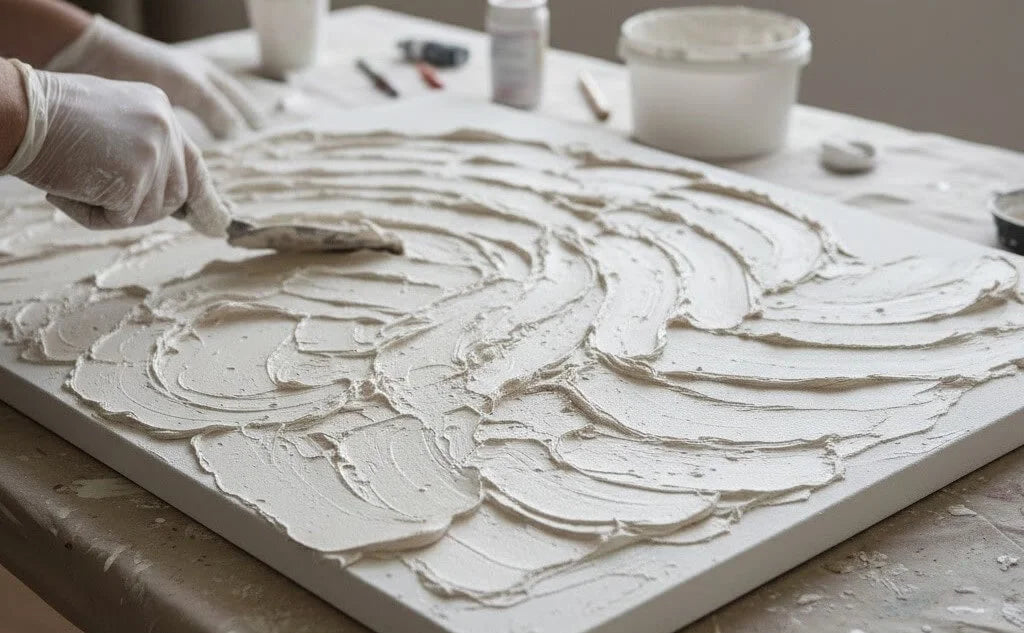
A knife in wet paste is the difference between a surface and a photograph of a surface. That process is what 3D textured canvas claims.
How textured wall art behaves in a room
Light is part of the work. Raking daylight or a picture light set 30–45 degrees off the face will draw lines along the ridges. Overhead cans aimed at glossy peaks will glare. A north window is kind to white plaster fields. Warm bulbs push gold and clay forward.
Scale changes the job. At eighteen inches, ridges are a detail. At fifty or sixty inches they become architecture. Extra-large textured wall art and extra-large empty walls belong together. A small textured souvenir on a long sofa wall reads as a sample.
Weight and hang. Paste and plaster add mass. Two hanging points, rated anchors or studs, D-rings—not a single sawtooth and not adhesive strips on a 60-inch relief.
Rooms. Pale living rooms can take clearer peaks. Bedrooms usually want mid values and lower gloss so the wall does not glitter at night. Offices should avoid flare on camera. Hallways can use a vertical textured field if shoulders will not brush it.
Color. White and sand show every ridge. Teal, rust, and gold need simpler textiles or they compete. Black-and-white texture is structure; colorful texture is climate.
Textured wall art versus a print on canvas
A print can show a photograph of impasto at any size. Side light will not invent height. Handmade 3D canvas takes drying time and can be sized to the wall you have. A print is the right object when you want a fixed image cheaply. It is the wrong object when the listing sold you shadow.
Touch, if you are allowed a corner: paint has tooth. Ink has a film. Edges of a painted wrap often continue the stroke; print wraps continue the photograph.
How to choose from a textured collection
- Demand an angled photo.
- Decide peak height: low scrape, moderate knife, or plaster slab.
- Match temperature to wood and light.
- Size to the sofa—about two-thirds to three-quarters of its width—or to the tall rectangle in a hall.
- Ask how deep work ships and how it should be stretched.
- Plan the lamp before the frame. Deep work often looks better in a floater or with no frame at all.
Canvashi’s textured listings (white relief, blue-beige sea, teal-green earth, pink-blue-gold) are climates. Pick the climate after you pick the shadow.
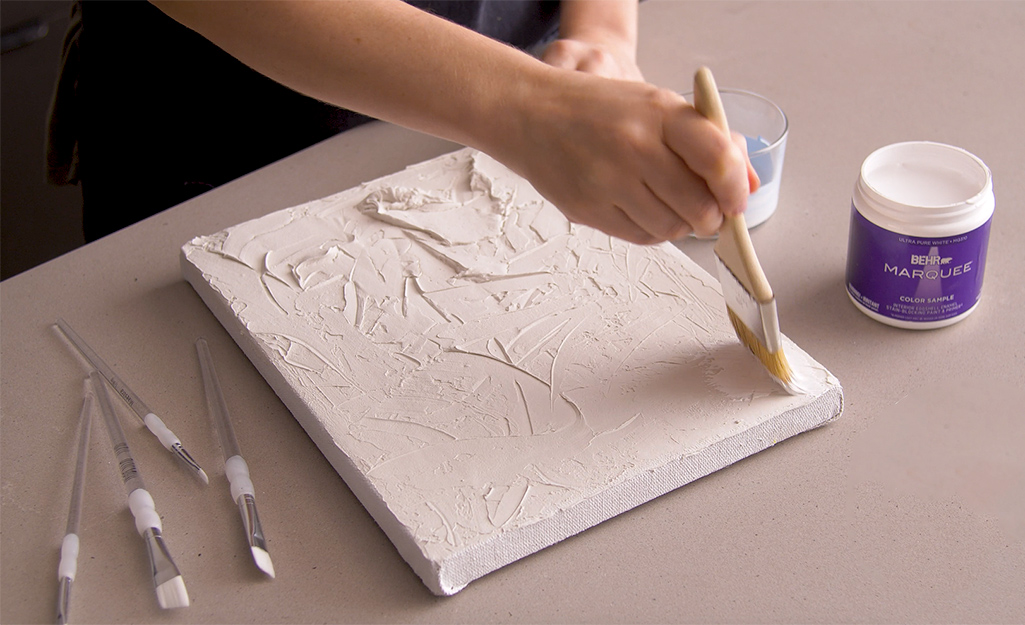
Building the ground and then coloring the ridges is how plaster wall art and knife canvas stay one object instead of a sticker on a print.
What the category is not
It is not automatically wabi-sabi, though cracked earth palettes overlap.
It is not museum relief sculpture.
It is not a filter called “texture” in a print file.
It is not guaranteed archival because it is thick; pigment and varnish still decide fading.
A short definition you can use
Textured wall art is painting-plus-surface for a wall: actual relief, usually abstract or near-abstract, large enough that light can work. 3D textured canvas is that object on a stretcher. Plaster wall art is the same idea with a plaster-like body. If the surface does not change between noon and evening, keep looking.
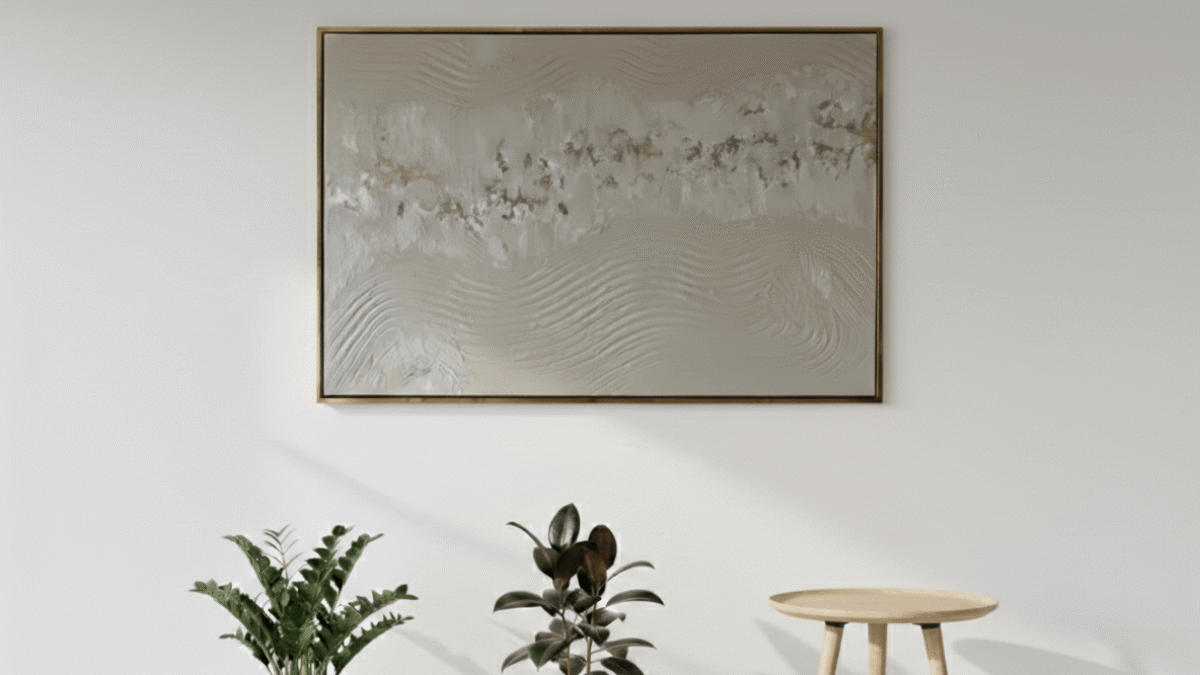
Once it is hung, walk past it twice in one day. If the wall looks different the second time, you bought textured wall art.
What is textured wall art?
Wall art with real physical variation—thick paint, paste, or plaster—so light can cast small shadows. A flat photo of roughness is visual texture, not textured wall art.
What is 3D textured canvas?
Hand-built canvas with raised medium on a stretcher. Depth is usually modest. It is not a printed 3D illusion and not a free-standing sculpture.
Is plaster wall art the same thing?
It is a subset. The ground is plaster or a plaster-like compound, then painted. It can be heavier and less flexible than acrylic impasto.
How do I know it is not a print?
Ask for raking-light photos. Standing paint changes as you move. A print of texture does not.
How should I light textured wall art?
From the side: a window or a picture light off-axis. Avoid shiny downlights on glossy peaks.
How large should it be above a sofa?
About two-thirds to three-quarters of the sofa width. Relief already adds weight.
Can deep texture ship rolled?
Sometimes, if the paste is flexible and you stretch it on arrival. High plaster is safer discussed before you order.