
Handmade vs Printed Canvas
Both objects can hang on the same wall and share the same word: canvas painting. They are not the same object. One is paint laid by a hand—brush, knife, or both—on fabric. The other is ink laid by a printer on fabric that has been prepared to look like painting. The photograph on a product page often hides the difference. Side light does not.
Canvas is only the support: woven cotton or linen, usually primed, stretched on wood. What sits on that support decides the category. Tate’s glossary treats painting as the act of applying paint or another wet medium to a surface, and as the object that results. A print, in the same glossary, is an impression made by transfer from one surface to another. Inkjet on canvas is still a print. Calling it a painting because the substrate is canvas is a sales habit, not a materials fact.
What “handmade” should mean
Handmade, in this comparison, means paint was applied to this piece of cloth. Layers can overlap. A knife can leave a ridge. A color can be mixed on the surface rather than only in a file. The work can be a unique composition, or it can be a studio repeating a published design. Those two handmade types are not equal as art-historical objects, but they are equal as objects: both have a painted skin.
Tate’s note on impasto is the museum name for the part a printer cannot do. Impasto is thick paint left standing. Venetian painters used it; modern painters made the surface itself a subject. A handmade canvas may be thin and stained, with almost no relief. It is still painted. Relief is the easiest proof, not the only one.
A studio that paints to order—Canvashi’s model—is handmade in the first sense: this canvas received paint. It is not a unique museum original unless the composition exists only once. Be precise when you buy. “Hand-painted” is about process. “Original” is about whether that image has been made before.
What “printed canvas” should mean
Printmaking in the traditional sense transfers ink from a matrix—plate, block, screen—to make an edition. Each impression can be an original print if the artist intended the edition that way. A poster of a painting is a reproduction. A canvas print of a photograph of a painting is also a reproduction. The substrate does not upgrade the status.
Giclée is the trade name buyers meet most often: a fine-art inkjet print. The word does not mean oil paint. It means pigment or dye sprayed through nozzles onto paper or canvas. Good giclée can be color-accurate, archival, and sharp. It cannot grow a knife ridge. Under a raking lamp you see a film, sometimes a faint dot pattern, and the weave of the cloth showing through an even layer.
Tate’s definition of a print is enough: transfer from one surface to another. The printer’s file is the matrix. The canvas is the impression. That can be a legitimate way to live with an image. It is not a painting.
The tests you can run at home
Light. Stand the work beside a window. Handmade paint throws small shadows where it stands up or where a dry brush skipped. A print stays graphically even. If the “texture” does not change as you move, it is likely visual texture only.
Edge and reverse. A painted wrap often shows continued strokes on the side. A print wrap shows the image continuing as a photograph, sometimes pixel-soft at the fold. The reverse of a print may show manufacturer marks, a mounting staple pattern, or a perfectly uniform coating. A painted canvas may show stain-through, pencil notes, or uneven primer.
Touch, carefully. If the owner allows a fingertip on an unvarnished corner, paint has temperature and tooth. A print has a skin. Do not scrape someone else’s work to win an argument.
Price and time. Handmade to order takes drying time. A print can ship from stock. Price alone is a weak test—cheap paint exists, and expensive giclée exists—but instant delivery of a “thick oil” at extra-large size is a warning.
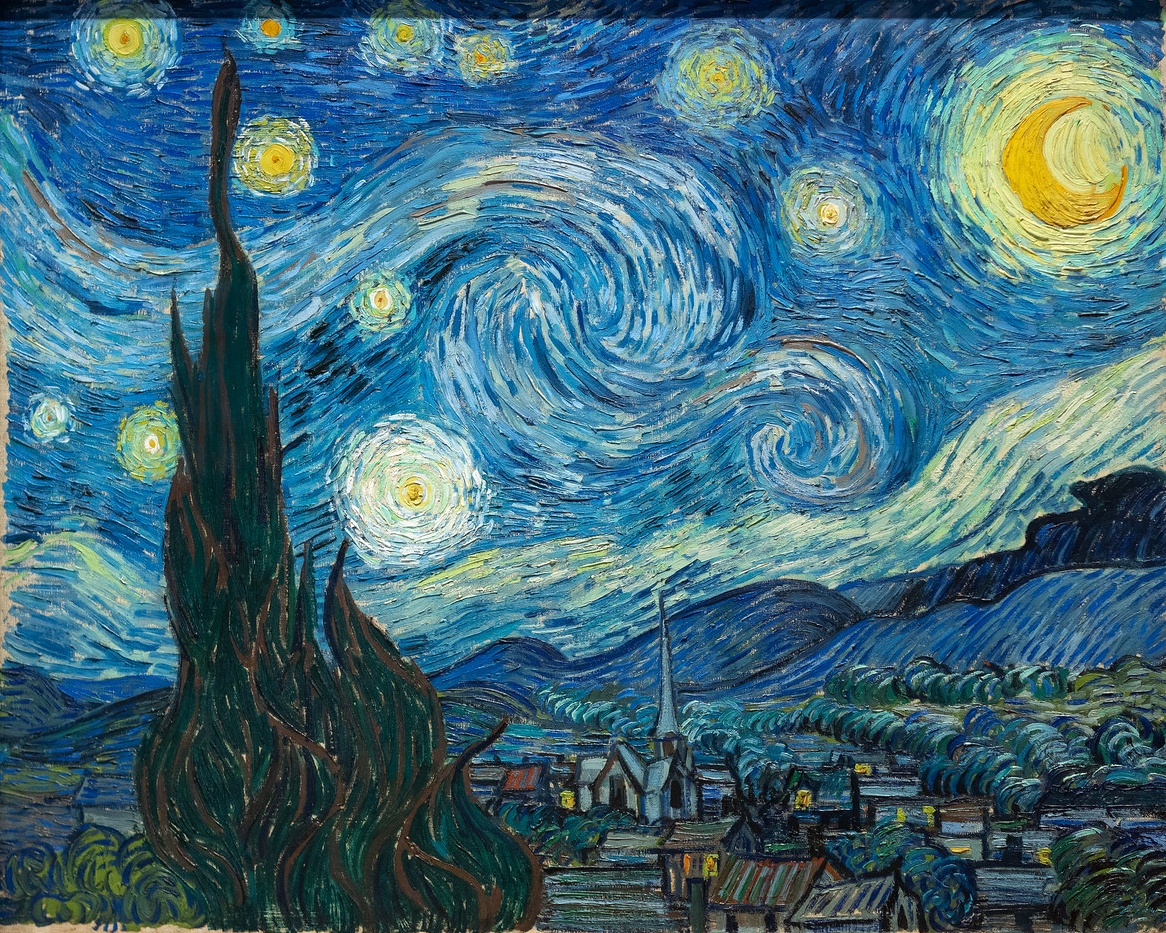
Van Gogh’s The Starry Night is the public demonstration. The sky is built from standing strokes. A canvas print of that painting can be beautiful in a hallway. It is still a picture of those strokes.
Why the difference matters on a large wall
At eighteen inches, a good print and a thin handmade stain can look close. At fifty or sixty inches, handmade paint keeps offering new edges as you walk past. A print offers the same photograph at every distance after the first step back. Extra-large rooms punish the shortcut.
Texture is the loudest gap. Printed “impasto” is a photograph of ridges. Handmade ridges occupy air. If the room has a side window, that is the whole argument.
Color is the quieter gap. Paint mixes on the surface and shifts with varnish and time. Ink is mixed in a profile. Neither is automatically more fade-proof. Pigment prints can be stable; cheap dyes can shift. Handmade work can chalk or yellow if the materials are poor. Ask about pigment, varnish, and light. Do not assume “oil” means permanent or “giclée” means fragile.
When a print is the right object
Choose a print when you want a specific existing image at a specific size, when budget is the constraint, when you need pairs that match exactly, or when the image is photographic. A print is honest if it is sold as a print.
Choose handmade when you want a surface, a custom size that is painted rather than enlarged, or a design that can be adjusted in color before it dries. Canvashi and similar studios exist for that middle: painted canvas after a listing photo, not a museum unicum and not an inkjet.
Do not buy a print because the listing says “oil painting on canvas” and the price is the print price. Do not buy handmade because you think it will appreciate like a catalogued artist. Buy the object you will live with.
A short buying order
- Decide whether you need a surface or an image.
- Ask what was applied: oil, acrylic, or ink.
- Ask for an angled photo and a side of the wrap.
- Size extra-large only if the object can carry the distance.
- Pay for paint if you want paint; pay less for ink if you want ink.
Handmade versus printed canvas is not a moral ranking. It is a materials ranking. Use the words that match the object, then hang it where the light can tell the truth.
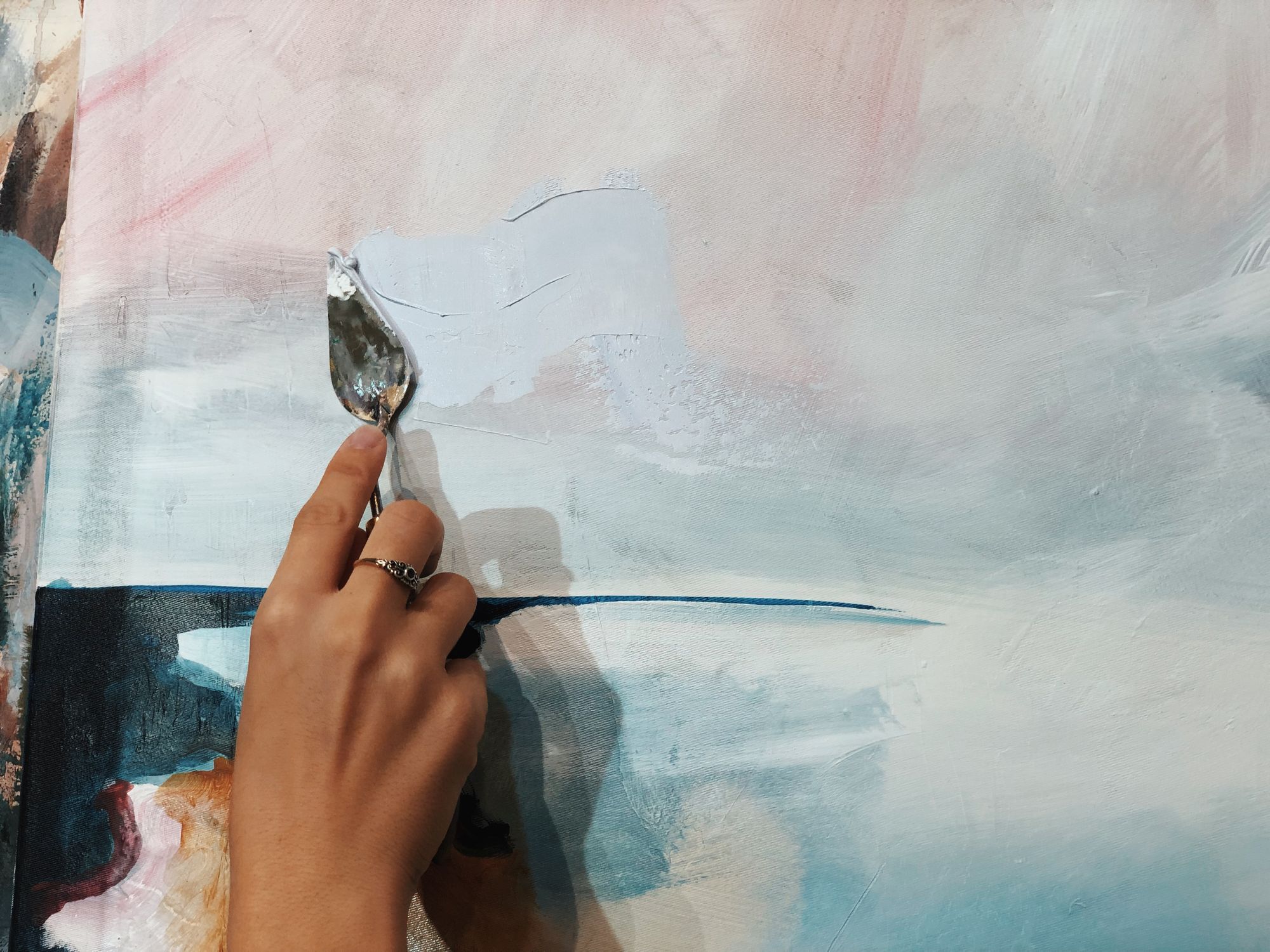
A knife leaving a ridge is a process no file can copy. If that process is what you want, the listing has to describe paint, not resolution.
Is a canvas print a painting?
No. A painting is paint applied to a support. A canvas print is ink transferred onto canvas. The cloth does not change the category.
What does handmade canvas mean in an online shop?
It should mean this piece was painted. It may still follow a repeated design. Ask whether the composition is unique or painted after a model.
What is giclée?
Giclée is a fine-art inkjet print. It can look sharp and last well. It is not oil or acrylic laid by hand.
How can I tell handmade from printed in a photo?
Ask for a raking-light close-up. Standing paint casts tiny shadows. A print of texture stays flat.
Which lasts longer?
It depends on pigment, varnish, ink type, and sun. Handmade is not automatically more archival. Keep either object out of hard daylight.
Is handmade canvas a good investment?
A to-order studio painting is usually décor with a real surface, not a resale market like a catalogued artist. Buy it to live with.
Can a print have texture?
Only visual texture, unless someone later adds paste on top of the ink. Raised gel on a print is a hybrid; ask what was added.