How to Choose Square Wall Art That Holds as an Object
A square canvas is a complete object. It does not travel with a sofa the way a wide field does, and it does not climb unused height the way a vertical slab does. Square wall art works when the composition is built as a balanced plane—geometry, a centered climate, nested values—and the wall you give it is also roughly square: an alcove, a pier between doors, a hall you pass close, a pair flanking a passage. A lonely small square in the middle of a nine-foot seating wall looks like a sample chip.
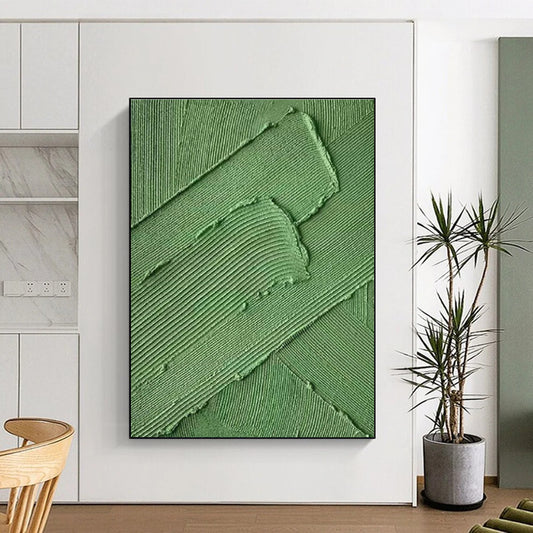
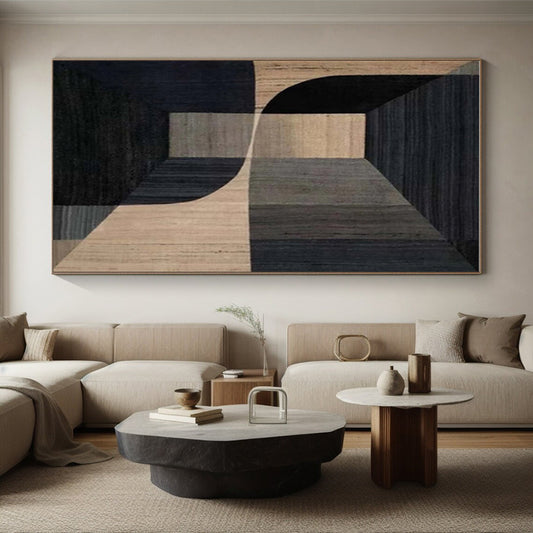
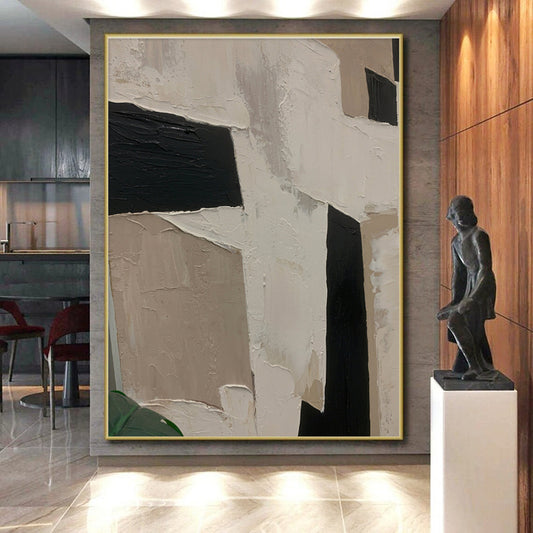
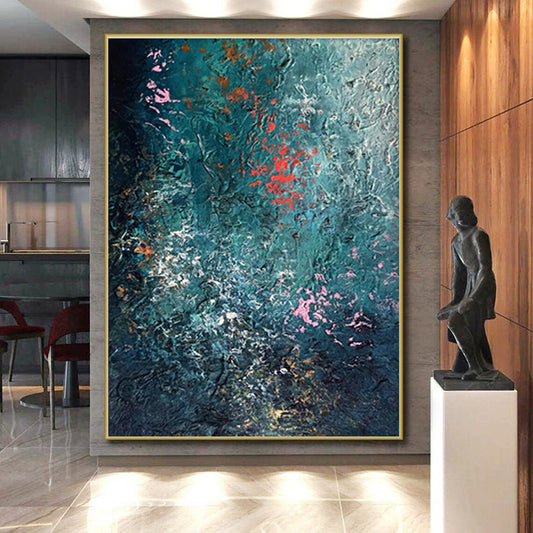
Square Wall Art here means hand-painted canvases composed inside equal sides: black-beige geometry, green textured fields, stacked blocks. The listing is a centered language. The piece you receive is painted to order in that language, not a landscape cropped into a box.
Why the square keeps coming back
The square is one of painting’s blunt tools. Wikipedia’s entry on Malevich’s Black Square is the famous extreme: a plane that refuses a view and asks to be seen as painting itself. You are not buying a manifesto. You are borrowing a useful warning. If the image still needs to be a panorama, the square will crop it. If the image is already a structure—blocks, a nest of values, a quiet field—the square will hold it.
Tate’s essay on Malevich’s Black Square underlines the same refusal of scenery. The square is not a window with equal margins. It is a face. Contemporary square wall art that still works in a house usually keeps some of that bluntness: fewer props, clearer geometry, a climate that can sit in the middle of the format without leaking out the sides.
Josef Albers spent decades proving the other half of the brief. MoMA’s Homage to the Square: Silent Hall belongs to a series of nested squares in which color changes the climate of the same shape. Albers said the palettes were different weathers. That is the shopping test for a quiet square. Do the values interact, or is it one fill with a border? Nested geometry, a darker core, a warmer ground—those survive at 30 or 40 inches. A tiny seascape stuffed into a box does not.
Where a square belongs—and where it fails
Measure the empty rectangle. If the wall is a wide seating span, a single square will almost always look undersized. Use a horizontal canvas there, or two or three squares designed as one run with tight gaps. Do not “make it square” because the collection is tidy.
If the wall is a tall unused strip, a square will float unless it is large enough to occupy most of that height—and then you may still want a vertical. The square’s home is the compact plane: the end of a hall, the wall over a narrow console, a kitchen-adjacent panel, an office wall behind a desk that the camera sees as a box, a pair of equal canvases on either side of a doorway.
Hanging a square is simpler than hanging a panorama, and easier to get slightly wrong. Center it on the empty box you measured, not on the whole room. Keep the visual middle near standing eye level in a passage. Over a console, leave a gap so lamps and objects can sit without crowding the lower edge. In a pair, match centers and keep the gap small and even; a wide gap turns two squares into two leftovers.
Light should be even. A downlight on the top edge of a square makes the upper band glare and the lower band die. Side light or a modest picture light across the face is kinder, especially if the surface is built. Offices on camera need mid values and low gloss so a pale square does not become a white tile.
What to put inside equal sides
The format punishes leftover subject matter. A wide horizon with empty sky on the left and right looks accidental. Choose structures that are already centered:
- Geometry: blocks, frames, a nest of planes.
- A field with a climate change inside the square, not a view that wants out.
- Quiet texture that reads as skin, not as a landscape model.
Color still needs temperature. Oak sits with clay, beige, and warm black. Gray rooms sit with ash and bone. A west window already supplies heat; a cooler nest of squares is often easier than another gold core.
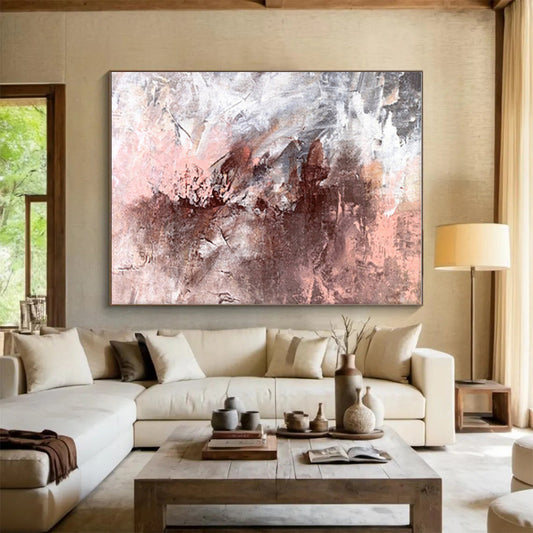
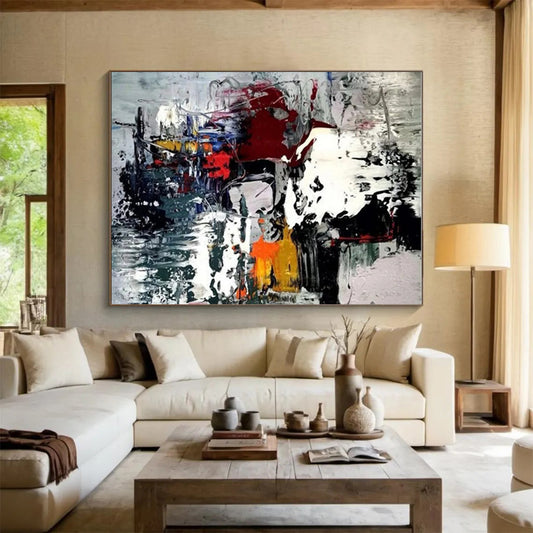
Handmade paint keeps a square from reading as a printed tile. Look for edges that were painted, value shifts inside the “empty” area, oil or acrylic on canvas, painted to order. Custom size exists when the alcove is 28 inches and the listing is 36.
A short buying order
- Decide whether the empty wall is actually a square, a wide span, or a tall slot.
- If it is a square or a pair of piers, measure that box.
- Choose geometry, a nested field, or a centered climate.
- Match temperature to wood, stone, and daylight.
- Check even light and sheen.
- Approve photos of the finished canvas before it ships.
Square wall art is an object. Give it a box that fits. On a sofa wall it will look unfinished. In the right slot, one handmade square is enough.
What is square wall art?
A canvas with equal sides, composed as a balanced plane—geometry, a nested field, a centered climate—not a wide landscape cropped into a box.
Where should I hang a square painting?
On a compact wall: alcove, hall end, over a narrow console, beside a door, or as a pair flanking a passage. Not as the only picture in the middle of a long sofa.
Can two squares replace one wide canvas?
Yes, if you measure the outer edges as one span and keep the gap small. Two squares with a large gap usually look like leftovers.
Will a large square work in a small room?
Yes, if it occupies the wall you measured and the field stays quiet. A timid small square in a small room looks lost. A calm, larger square can finish the box.
How is hand-painted square art different from a print?
Handmade edges and value shifts keep the plane from reading as a tile. A print stays one fill. Confirm oil or acrylic, and ask for an angled close-up if the surface is built.
Can I order a custom size?
Yes. Send the width of the empty box and a daytime photo. Keep the same centered structure as the listing, and approve photos before shipping.