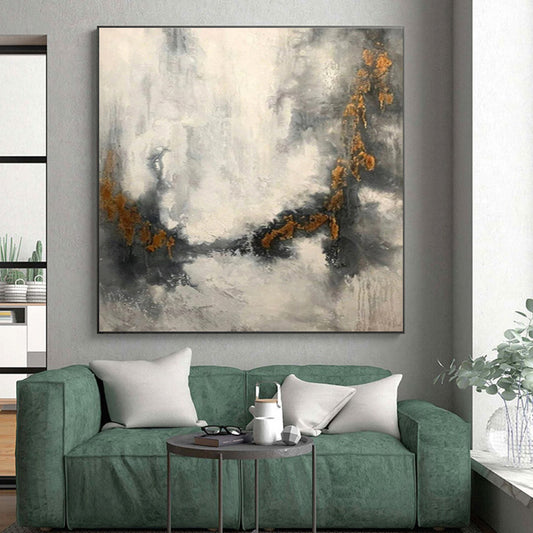
How to Choose Gold Wall Art: A Buyer’s Guide to Hand-Painted Abstract Canvas
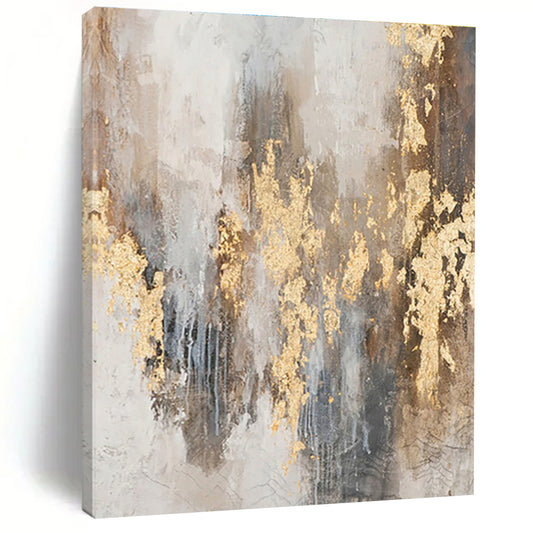
Gold is one of the few colors that can make a wall feel finished rather than decorated. Used well, Gold Wall Art adds warmth and a quiet sense of luxury. Used poorly, it reads as costume jewelry: too shiny, too small, or stacked against every other metal object in the room. This guide is for shoppers looking at hand-painted abstract canvas—especially oversized, textured pieces that mix gold with black, gray, white, blue, teal, or muted jewel tones.
Why gold still works in contemporary rooms
Artisans have beaten metal into gold leaf for thousands of years because the material is thin, stable, and reflective in a way ordinary pigment is not. That quality moved from sacred panels and mosaics into modern interiors through artists who treated gold as a surface, not only a symbol.
Gustav Klimt’s The Kiss (1907–08) is the familiar example: oil and gold leaf share one plane so pattern and metal belong to the same image. A quieter counterpart is Agnes Martin’s Friendship (1963) in the collection of The Museum of Modern Art—a six-foot-square grid of gold leaf scored by hand to reveal the paint underneath. The two works give buyers a useful split. Gold can dominate a composition, or it can sit as a thin, light-catching layer over texture. Most residential gold abstracts follow the second path: metallic accents on a painted field, not a fully gilded wall.
What “gold” on a canvas actually is
Listings often blur three materials. Genuine gold leaf is a sheet of real gold, usually 22–24 karat, laid over adhesive. It keeps its color and has a soft, irregular sheen. Imitation leaf is typically copper and zinc; it can look right at a distance but may tarnish if unsealed. Metallic acrylic or gold-tone paint is the practical choice on large canvases. It covers quickly, holds texture paste, and ships more safely than a fully leafed surface.
Treat “gold wall art” as a visual family, not a materials certificate. Read the medium line. Study close-ups of ridges and edges. If a product mentions shimmering gold accents or metallic golds, expect paint or mixed metallic media rather than museum leaf across the whole canvas. On an oversized living-room piece, well-applied metallic paint on heavy texture often looks more intentional than a fragile sheet that wrinkles in transit.
Hand-painted canvas still beats a metallic print. Brush marks, scraped grounds, and raised edges catch light at different angles. A print of gold is a photograph of shine; a painted surface is shine itself.
Color pairings that hold up
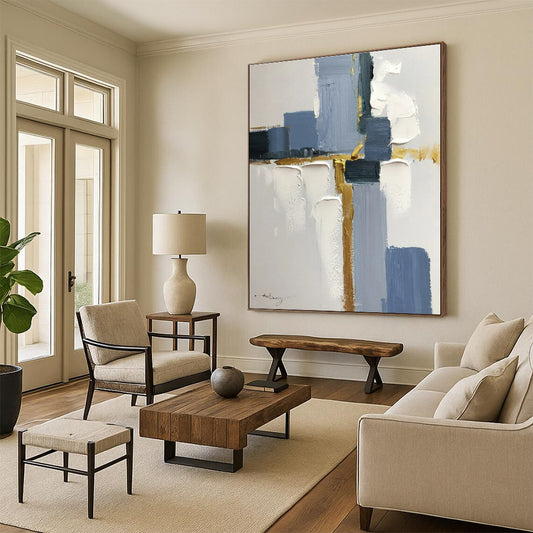
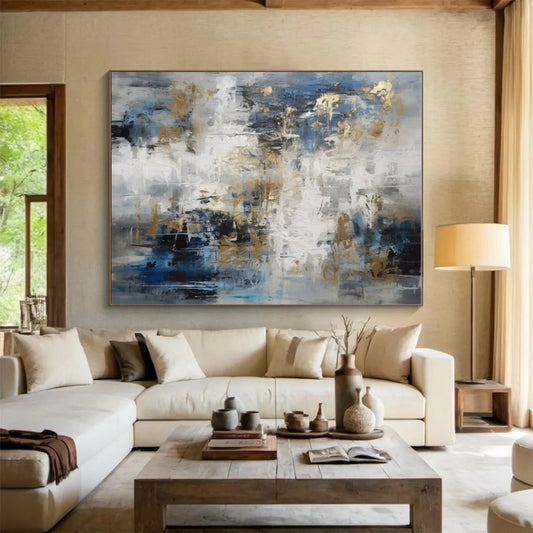
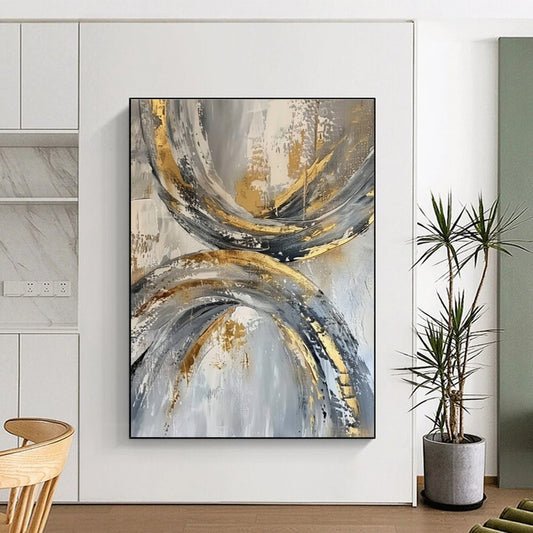
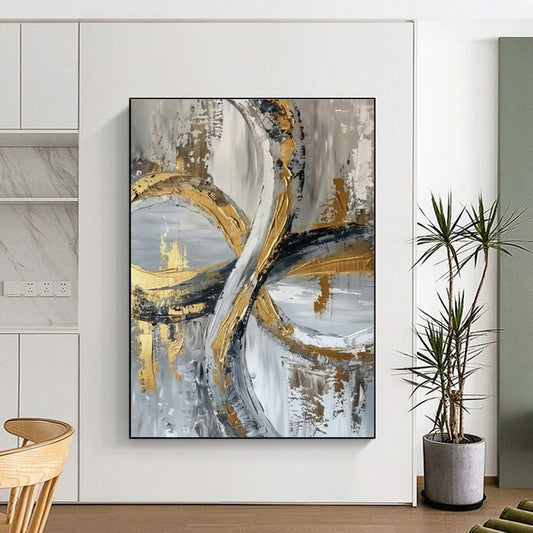
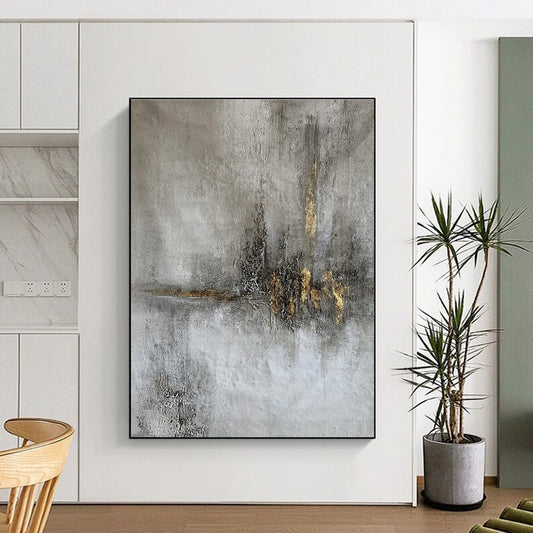
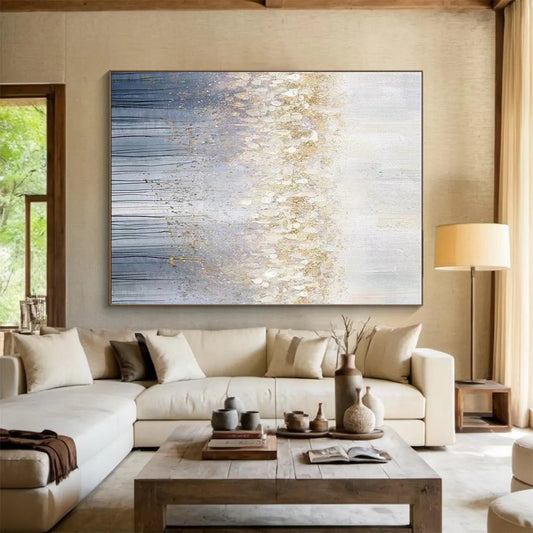
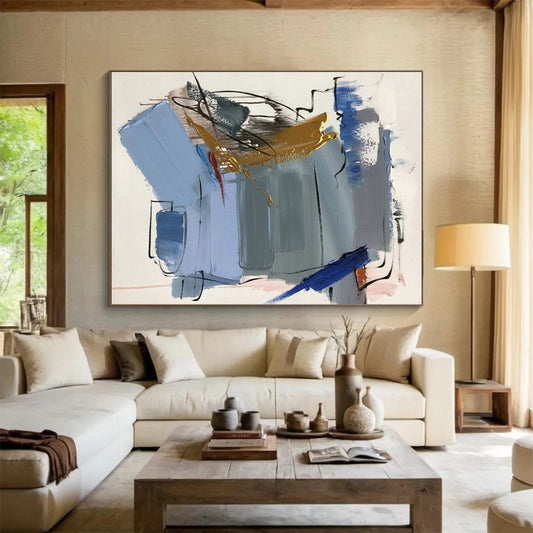
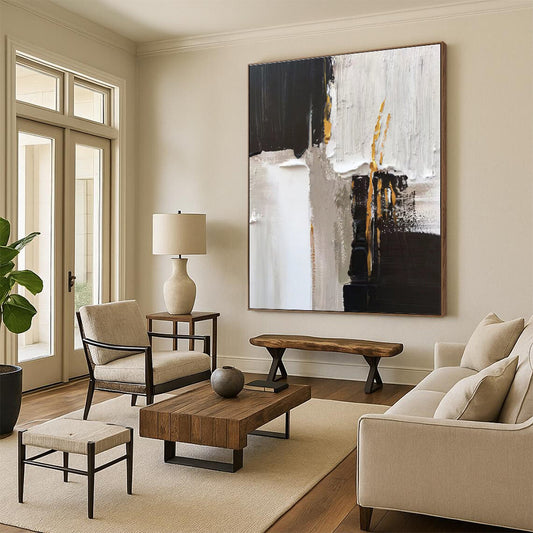
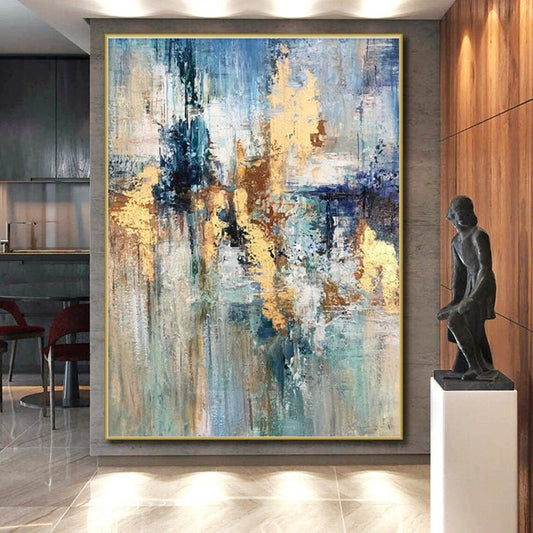
Gold is an accent, not a room color. The pairings that stay convincing on hand-painted abstracts are straightforward. Black and gold gives the highest contrast and suits dark sofas, stone, and walnut—keep other metals quiet so the canvas stays the brightest object. Gray, white, and gold reads as soft luxury above a light sofa or in a bedroom. Blue or teal with gold feels cooler; pair it with linen, oak, and daylight rather than a full set of brass hardware. Purple or pink with gold works as a dining-room or dressing-room statement, not as the only color in a restful bedroom.
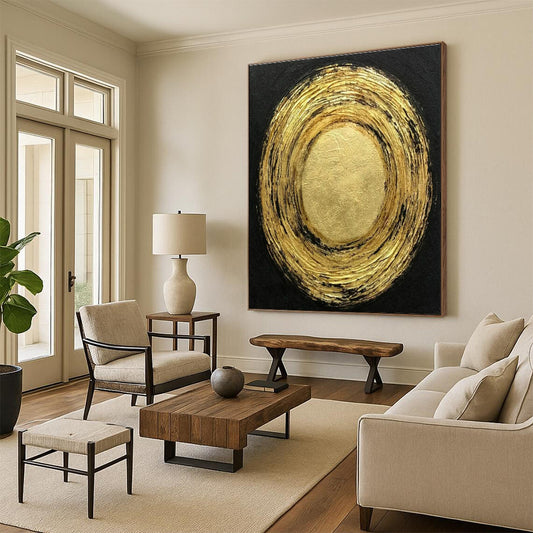
If the room already has brass lamps and gold mirrors, choose a painting where gold is a vein, a circular motif, or a broken field—not a flood. Warm white, greige, charcoal, and deep olive walls let metallic passages read clearly.
Size, shape, and placement
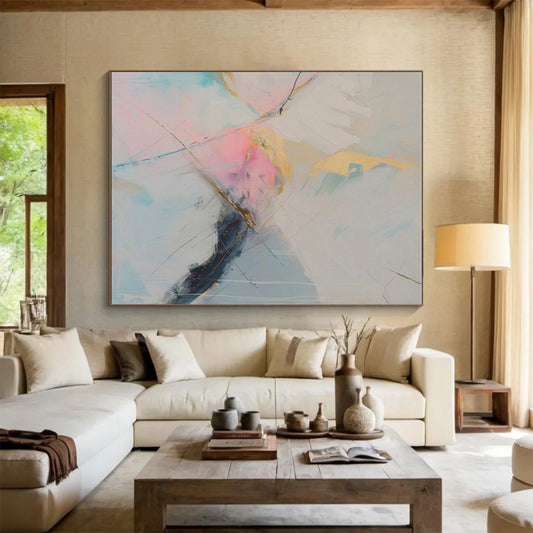
Artwork above a sofa, bed, or console should span about 60–75 percent of the furniture width. A 90-inch sofa wants a canvas roughly 54–68 inches wide, or a pair that reads as one mass. Leave 6–8 inches between the furniture and the bottom of the work. On an empty wall, keep the visual center near 57–60 inches from the floor.
Match shape to the architecture. Horizontal canvases settle a living room and a bed wall. Circular and square formats work over a fireplace or a centered console. Vertical pieces suit entries, stair landings, and the strip between windows. Oversized single canvases serve high ceilings better than a cluster of small gilt frames. Textured gold abstract art also needs breathing room: give it a quiet field so the metal can change with morning and evening light.
Light, framing, and care
Cool white LEDs can make cheap metallic paint look brassy. Warm, dimmable light (about 2700–3000K) and a slight wash from above or the side will rake across ridges without a hot spot. Avoid hanging a highly reflective piece directly opposite a bare window if glare will sit in the seating line.
Gallery-wrapped canvas with painted sides is the cleanest contemporary look. If you frame, use a slim float frame in black, oak, or muted champagne—not a heavy gilt moulding that competes with the paint. Dust with a dry microfiber cloth. Do not spray cleaner onto metallic areas. Keep the work out of persistent damp and out of hard, all-day sun.
How to buy with fewer regrets
Check five things before you order: hand-painted canvas versus print; whether the gold is leaf, foil, or metallic paint; width against your furniture; custom sizing; and shipping—rolled or stretched. Hand-painted Gold Wall Art is most convincing when the gold is concentrated, the texture shows in close-ups, and the rest of the palette already exists in the room: a charcoal sofa, a blue rug, a warm oak floor. Choose the piece that completes a palette you live with, not a second metal theme you then have to decorate around.
What is the difference between gold wall art and gold-leaf art?
Gold wall art describes color and finish. Gold-leaf art uses thin sheets of gold or imitation leaf applied by hand. Many abstract canvases use metallic acrylic for large passages and reserve leaf or foil for highlights. Always read the materials line.
How large should gold abstract art be above a sofa?
Aim for 60–75 percent of the sofa width, with 6–8 inches of space above the furniture. On a high wall, one large canvas usually looks more considered than several small gold prints.
Does gold wall art work in a bedroom?
Yes, if gold is an accent against gray, cream, soft blue, or muted purple rather than a high-contrast black field. Softer circular or textured compositions feel calmer than sharp geometric blocks.
Will metallic gold paint tarnish?
Quality acrylic metallic paint used indoors and sealed as a finished painting is stable. Unsealed imitation leaf that contains copper can dull in humid air. Genuine gold leaf does not tarnish.
How should I light a textured gold canvas?
Use warm, dimmable light and a slight side or picture-light wash so ridges catch light. Flat, cool overhead lighting flattens both texture and metal.