How to Choose Geometric Art That Organizes a Wall Without Looking Like a Diagram
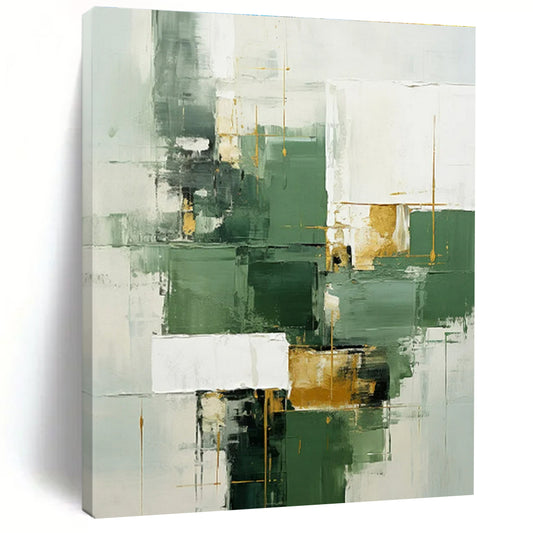
Geometry on a wall is a planning tool. Circles, blocks, grids, and hard edges can steady a busy room or make a calm room look unfinished. The difference is not the shape. It is how many colors the shape has to carry, how sharp the edge is, and whether the furniture already repeats the same grid. This guide is for hand-painted Geometric Art on oversized canvas—blocks, circles, and mixed planes in black and white, beige and brown, or high-chroma mixes—not for small framed prints of Bauhaus posters.
What geometric painting is actually doing
Geometric abstraction is painting built from measurable forms rather than from landscapes or figures. Piet Mondrian’s Composition in Red, Blue, and Yellow (1937–42) in the collection of The Museum of Modern Art is the familiar extreme: black lines, primary blocks, no gesture. Josef Albers’s Homage to the Square: Silent Hall (1961), also at MoMA, is the other extreme: nested squares where the subject is how one color changes the next.
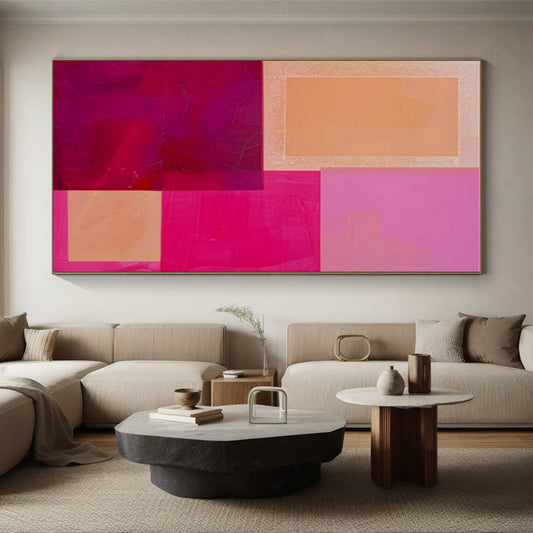
Those two museum examples give a buyer a useful split. Some geometric canvases are architecture—lines that divide the wall. Some are color machines—simple shapes used so hues can press against each other. Residential work sits between them. A beige-and-black block painting behaves like furniture. A pink-purple-orange geometric field behaves like a signal. Choose the first if the room already has pattern. Choose the second if the room is quiet and needs a single loud object.
Read the geometry before you read the palette
- Hard-edge blocks and grids look most “designed.” They suit offices, dining rooms, and modern sofas with clean legs. They fight busy rugs and tufted furniture.
- Soft-edge circles and rounded planes are easier in living rooms and bedrooms. A circle does not cut the wall as hard as a grid.
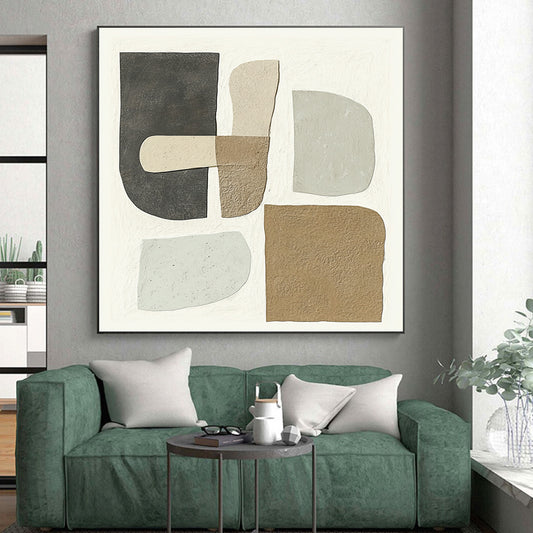
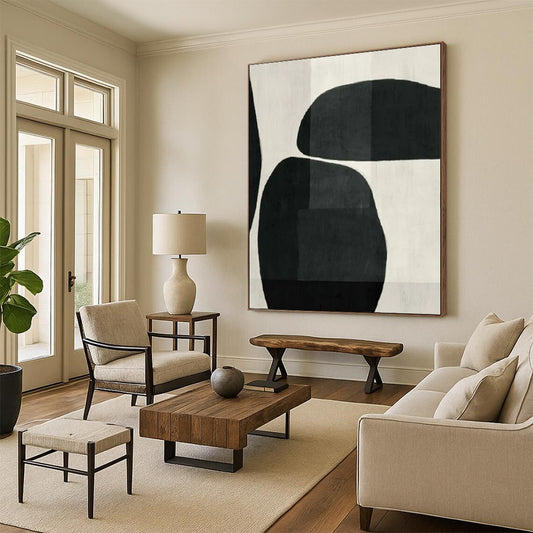
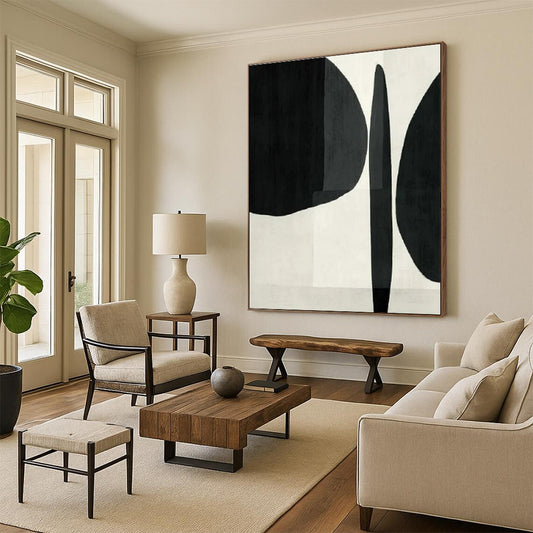
- Black, white, and beige geometries are the most livable. They organize a wall without adding a new hue.
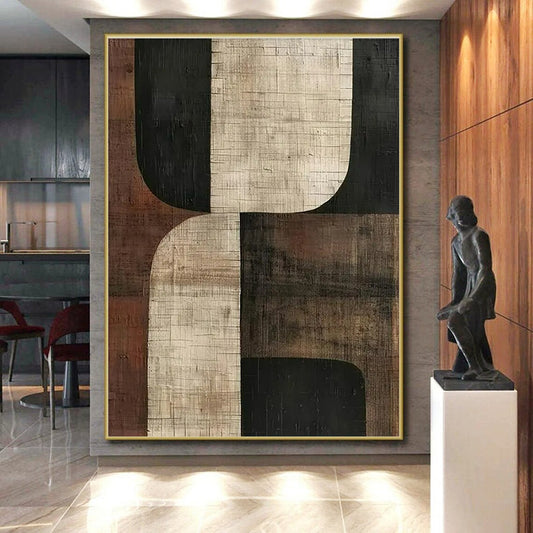
- Brown, beige, and gray geometries sit next to oak, walnut, and stone. They are the quietest oversized option.
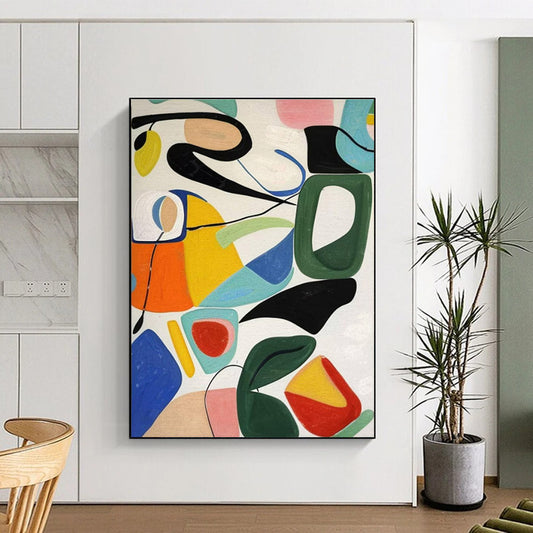
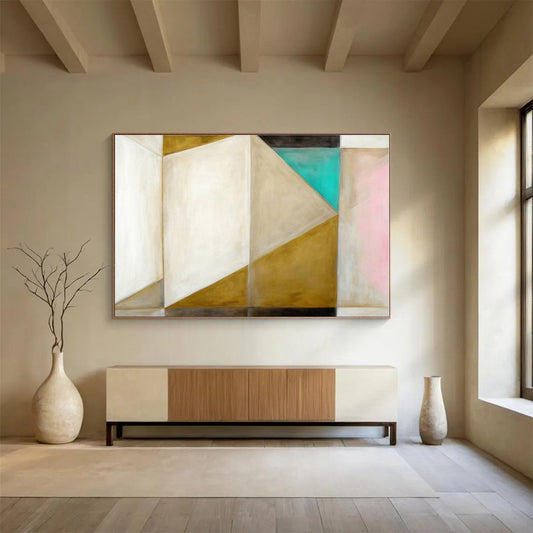
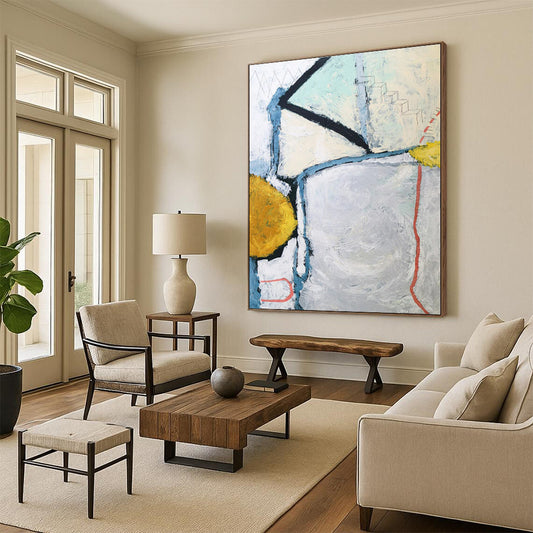
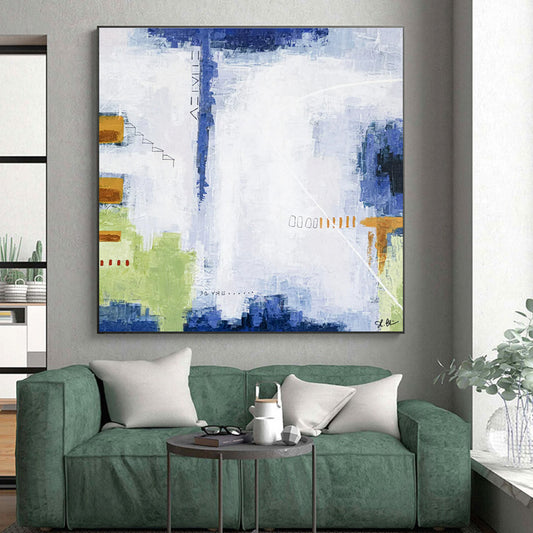
- Multicolor geometries—yellow-blue-white, gray-yellow-red, pink-purple-orange, gold-teal-pink—need a neutral wall and almost no other pattern in the same sightline.
Count the shapes. Three large planes will hold a sofa wall. A canvas packed with small tiles can look like wrapping paper unless you hang it as a single mass on a very clean wall.
Pairings and rooms
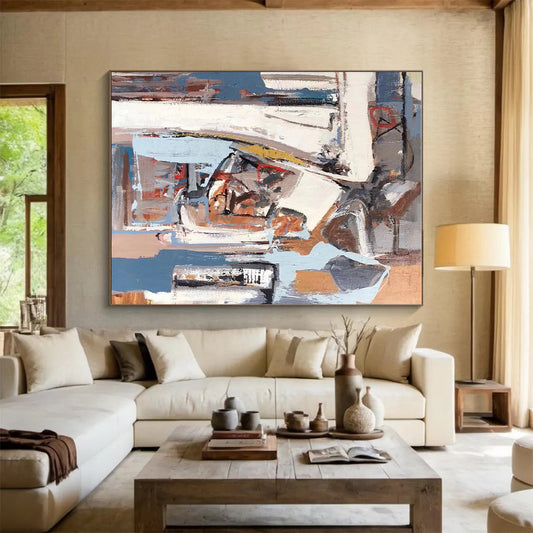
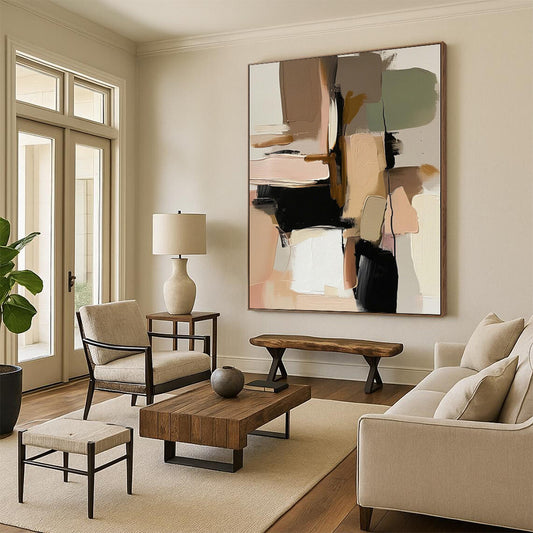
Black and white geometric art is the default for contemporary rooms. It can take a slim black frame or none. Beige and black is softer and works above a cream or oatmeal sofa. Brown, beige, and gray belong in studies and rooms with wood floors. Blue-gray-white-brown mixes feel architectural and coastal at once. High-chroma geometrics belong on a dining wall, a wide hallway, or an office that can tolerate alertness. They are a weak choice for the wall you face in bed.
Match the geometry to the architecture, not to a trend word. A long horizontal block composition settles a sofa. A square or circular format works over a console or fireplace. Vertical stacks suit the strip between windows and a stair landing. Oversized single canvases serve high ceilings better than a cluster of small geometric prints, which can look like leftover tiles.
Neutral walls help. Warm white, greige, charcoal, and clay let the shapes register. A wall already covered in geometric wallpaper does not need another grid. If the rug is a kilim or a check, choose circles or large soft blocks rather than more right angles.
Size, edge, and how close you will stand
Above a sofa, bed, or console, aim for about 60–75 percent of the furniture width. A 90-inch sofa wants a canvas roughly 54–68 inches wide. Leave 6–8 inches between the furniture and the work. On an empty wall, keep the visual center near 57–60 inches from the floor.
Hard-edge painting rewards a little distance. If you sit six feet from the wall, crisp blocks stay crisp. If the canvas hangs in a narrow hall where you pass two feet away, soft edges and visible texture keep the work from looking printed. That is the practical case for hand-painted geometric canvas: the plane can stay flat in design while the surface still has scrape, ridge, and slight variation. A poster of a Mondrian grid has the diagram without the surface.
Light, framing, and a short checklist
Warm, dimmable light (about 2700–3000K) keeps beige and brown geometries from going muddy and keeps multicolor blocks from going neon. Cool overhead LEDs flatten black-and-white grids into office signage. Gallery wrap with painted sides is the cleanest look for this category. If you frame, use a slim float frame in black, oak, or white that repeats a color already on the canvas. Do not add a heavy gilt moulding to a hard-edge painting; the frame becomes a competing rectangle.
Dust with a dry cloth. Keep the work out of damp and out of hard, all-day sun. Measure the furniture first. Decide whether the canvas should organize the room (few colors, large shapes) or animate it (more colors, tighter shapes). Then stop adding other grids to the same view—no second geometric pillow set, no competing gallery of small squares.
What rooms work best for geometric art?
Offices, dining rooms, and modern living rooms take hard-edge blocks and black-and-white grids well. Bedrooms and sitting rooms usually need softer circles or beige-brown geometries. Avoid stacking a tight grid over a patterned sofa and a patterned rug.
Is geometric art too cold for a home?
Only if the shapes are small, the edges are razor-sharp, and the palette is pure black and white under cool LEDs. Large planes, visible texture, and a beige or brown field warm the same structure.
What colors pair with geometric shapes on a canvas?
Black, white, and beige are the most flexible. Brown and gray quiet the design. One strong accent—gold, teal, red, or pink—works if the rest of the canvas stays neutral. Multicolor geometries need a plain wall.
What size geometric canvas should I hang above a sofa?
Use 60–75 percent of the sofa width and leave 6–8 inches above the back cushions. One oversized canvas usually looks more considered than several small geometric prints.
Is hand-painted geometric art better than a print?
Yes if you will see the work up close. A print can copy the diagram. Hand-painted layers keep the blocks from looking like a graphic file. Texture is what separates a canvas from a poster of a grid.