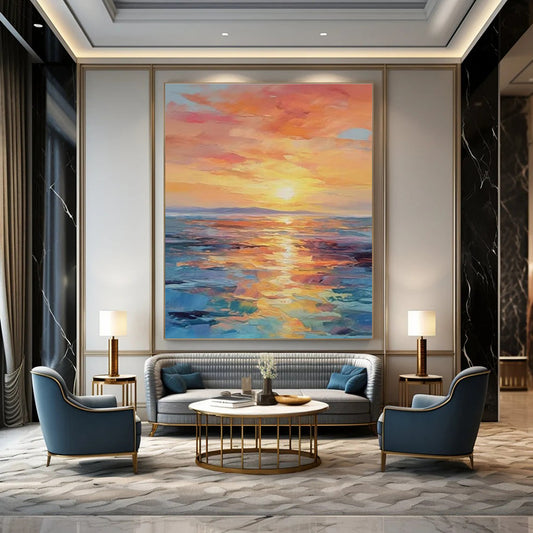
How to Choose Vertical Wall Art for Unused Height
A tall empty strip is not a wide wall turned on its side. Vertical wall art has a different job: use the height you are wasting—beside a door, in a hall, over a console, in the gap a high ceiling leaves above ordinary furniture. A horizontal field crammed into that slot looks cropped. A timid square floating in the middle of it looks lost.
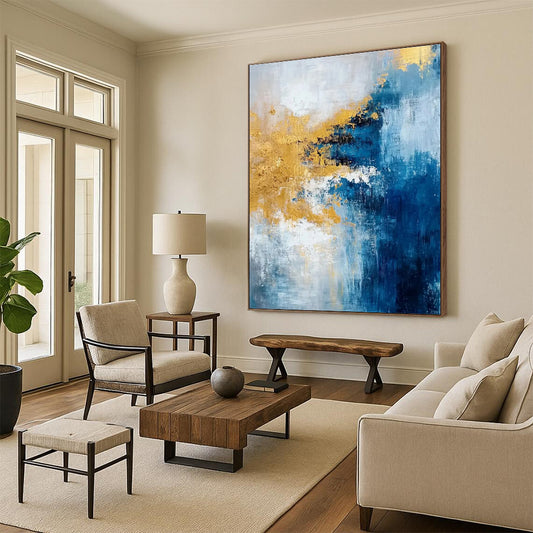
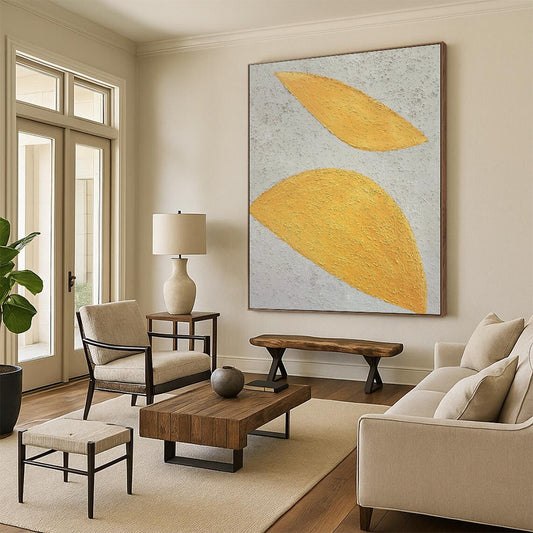
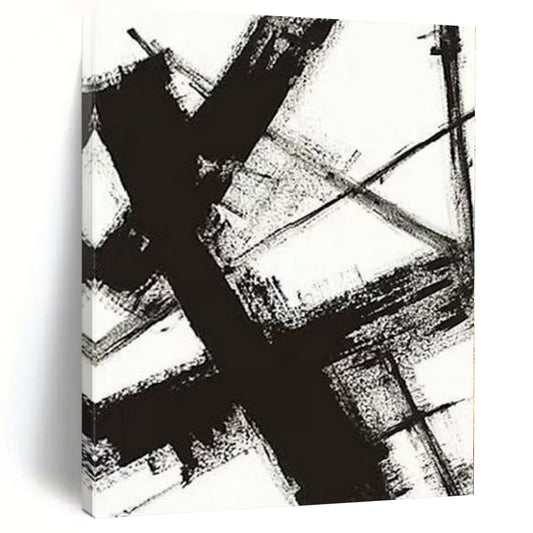
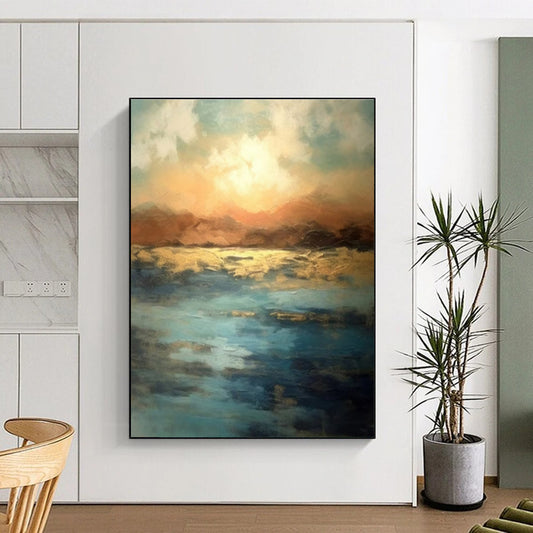
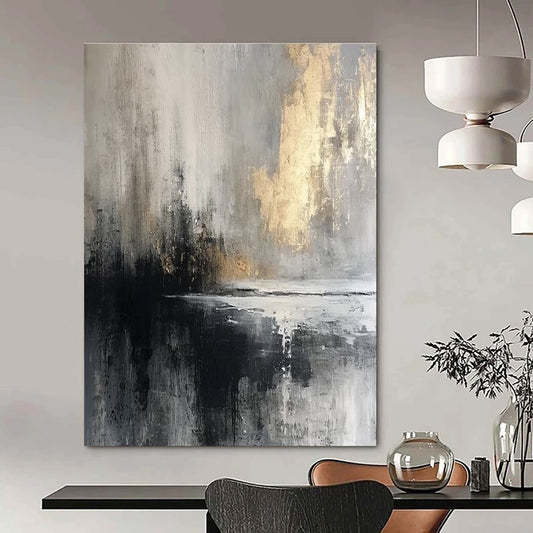
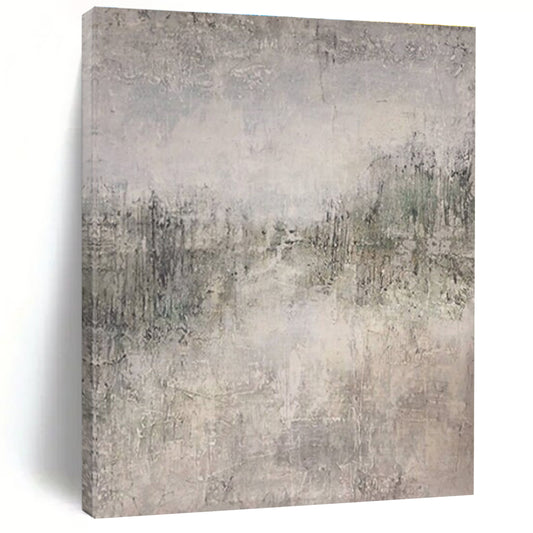
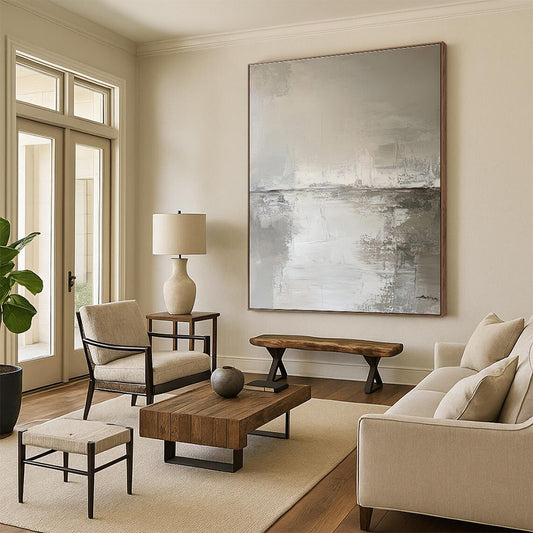
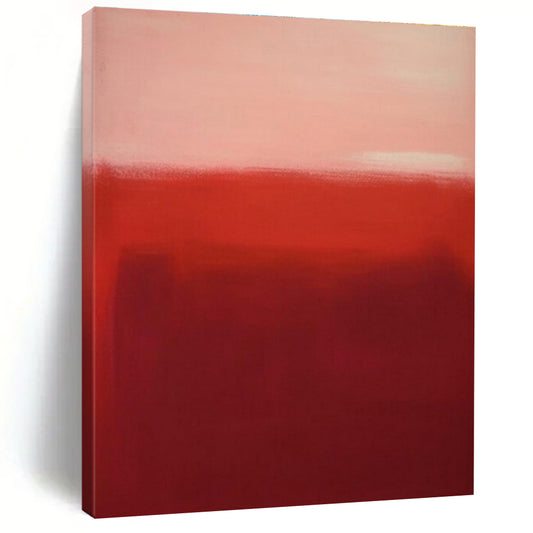
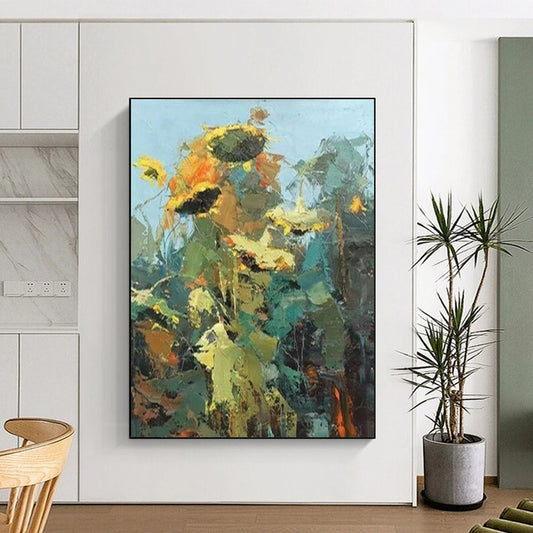
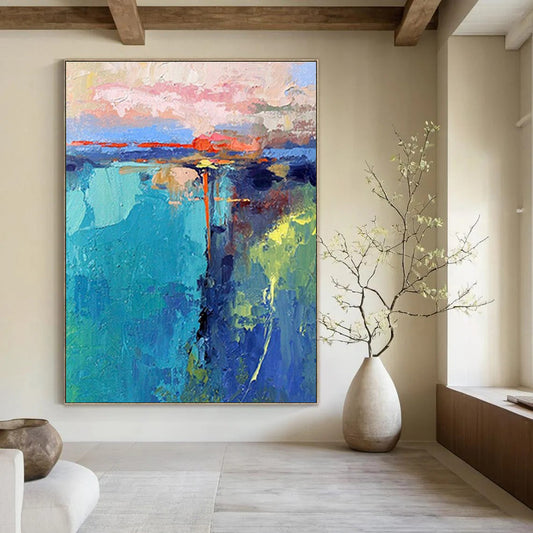
Vertical Wall Art here means hand-painted canvases built as upright planes: geometric stacks, a rising field, a narrow climate of gray or sunset color. The listing is a tall language. The piece you receive is painted to order in that language, not a landscape rotated 90 degrees.
Tall format is an old wall habit
East Asian painting treated the upright plane as a primary way to live with an image. Wikipedia’s article on the hanging scroll is clear: the format is for vertical compositions meant to hang on a wall, not to be read section by section on a table. The object is a column of attention. You do not need silk mounts. You need the same spatial idea. The canvas should read as a descent or a rise, not as a wide view forced into a doorway.
The Met’s essay on painting formats in East Asian art separates hanging scrolls from handscrolls for that reason. Horizontal work unfolds in time. Vertical work occupies a wall at once. A contemporary hallway is closer to the hanging scroll’s problem than to a sofa-wall panorama. Choose marks that can travel up: stacked geometry, a vertical split, a field that darkens or lightens as it climbs.
Western painting learned a related lesson with the tall abstract plane. The Whitney’s note on Barnett Newman’s The Promise describes early “zip” paintings: a field divided by narrow vertical bands. The stripe is not a decoration on a landscape. It reorients the canvas. You are not buying a Newman. You are borrowing the test. Does the tall canvas have an upright structure, or did someone take a sunset and pinch it?
Where a vertical canvas actually belongs
Start with the empty rectangle you have, not with the word “statement.”
Hallways and entryways: a vertical plane at the end of a run, or between doors, gives the corridor a stop. Keep values mid if the space is narrow and already dark.
Beside a window or bookcase: a tall slab can balance a vertical architectural line. Match temperature to the wood or the frame, not to one pillow.
High ceilings over ordinary furniture: the unused height is the problem. A short horizontal over a sofa leaves a bald strip of drywall to the cornice. A vertical piece works when that unused strip is the wall you are solving—next to the seating, in an alcove, on a chimney breast—not when you plant a skinny canvas in the dead center of a nine-foot sofa.
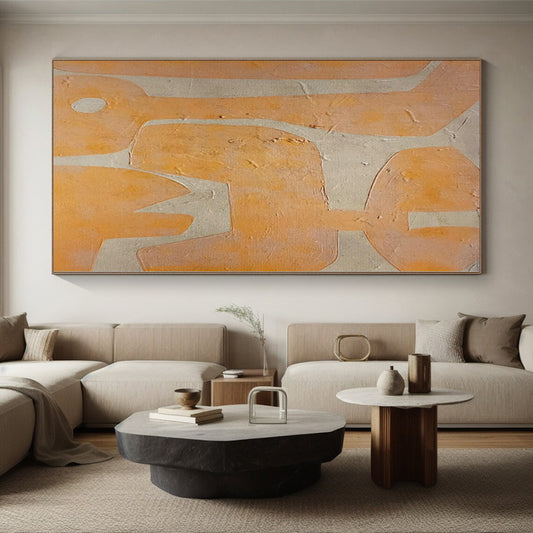
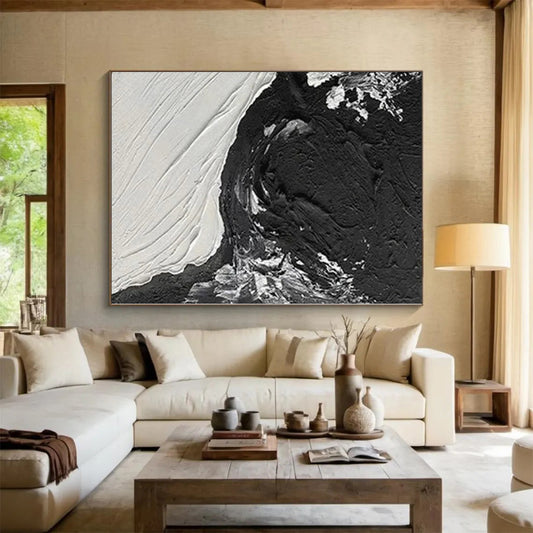
What vertical does poorly: the long seating wall. A single tall panel over an 84-inch sofa usually looks like a sample. If the wall is wide, use a horizontal field, or two or three verticals measured as one span with tight gaps. Do not use height as a substitute for width.
Measure both directions. Note the distance from the top of the console, banister, or sofa back to the ceiling line you want to keep clear. Leave breathing room at the cornice. The visual center of a tall canvas can sit a little higher than a landscape’s center, but if the whole object floats into the ceiling it has left the furniture behind.
Light runs differently on a tall plane. A downlight at the top will bleach the upper third and leave the foot of the canvas in shade. Side light or a pair of modest picture lights is kinder. Offices on camera should avoid glossy peaks at head height.
Handmade tall work versus a cropped print
A printed “vertical” is often a wide photo with the sides cut off. Hand-painted vertical work is composed as an upright: stacked blocks, a rising texture, a column of weather. Look for a structure that still makes sense if you cover the left and right margins. Confirm oil or acrylic, painted to order. Ask for a custom height if the standard size dies two feet below the ceiling.
Texture can help a tall quiet field from reading as a door panel. Heavy relief at the top of a canvas that must ship rolled is a risk—ask whether high peaks should travel stretched.
A short buying order
- Photograph the tall empty strip at the hour you use it.
- Measure height and width of that strip, not the whole room.
- Decide stacked geometry, a vertical split, or a rising field.
- Match temperature to wood, stone, and daylight.
- Check how light falls from ceiling to floor.
- Approve photos of the finished canvas before it ships.
Vertical wall art is for unused height. Used that way, one tall handmade plane finishes the slot. Used as a skinny substitute for a sofa painting, it looks unfinished.
What is vertical wall art?
A canvas composed as an upright plane—taller than it is wide—meant for hallways, entries, alcoves, and unused height. It is not a horizontal landscape rotated.
Where should I hang a vertical painting?
On a tall, relatively narrow rectangle: end of a hall, beside a door or window, over a console, on a chimney breast. Not as the only object in the middle of a long sofa wall.
Will a tall canvas work with high ceilings?
Yes, if you are solving the unused height. A short picture under a two-story void floats. A vertical plane that occupies most of that strip looks intentional.
Can I use several vertical panels over a sofa?
Yes, if you measure the outer edges as one span and keep the gaps small. One skinny canvas alone over a wide sofa usually looks like a leftover.
How is hand-painted vertical art different from a cropped print?
Handmade work is built as a rise or a stack. A cropped print is a wide image with the sides missing. Ask whether the composition still holds if you ignore the left and right edges.
Can I order a custom height?
Yes. Send the height of the empty strip and a daytime photo. Keep the same upright language as the listing, and approve photos before shipping.