

Swatch x Guggenheim: Transforming Masterpieces into Wearable Timepieces
In the ever-evolving intersection of art and fashion, Swiss watchmaker Swatch has once again bridged the gap between museum galleries and everyday accessories. On January 15, 2026, Swatch unveiled its latest collaboration with the renowned Solomon R. Guggenheim Museum in New York and the Peggy Guggenheim Collection in Venice. This partnership, dubbed the Swatch x Guggenheim Collection, features four distinctive watches inspired by iconic works from 20th-century masters: Edgar Degas, Claude Monet, Paul Klee, and Jackson Pollock. Priced between $105 and $115, these timepieces make high art accessible, allowing wearers to carry a piece of cultural history on their wrists. As Swatch CEO Vivian Stauffer noted, the collection embodies a shared vision that "art should be accessible, lived with, and experienced beyond museum walls."
Swatch, founded in 1983 by Nicolas Hayek, revolutionized the watch industry with its affordable, colorful, and innovative designs. Known for disrupting the luxury market dominated by traditional Swiss brands like Rolex and Omega, Swatch emphasized fun, creativity, and mass appeal. The brand's name, a contraction of "second watch," positioned it as an accessory rather than a heirloom, often featuring bold graphics and collaborations with artists and institutions. This latest venture is part of Swatch's ongoing Art Journey series, launched in 2023, which has previously teamed up with institutions like the Museum of Modern Art (MoMA) in New York, the Louvre Abu Dhabi, and estates of artists such as Jean-Michel Basquiat and René Magritte. The Guggenheim partnership dates back to the 1990s, but this collection marks a fresh chapter, focusing on translating emotional and visual depth from canvas to dial.
The Guggenheim Museum, designed by architect Frank Lloyd Wright, is a modernist icon itself, with its spiral ramp facilitating a unique viewing experience. Opened in 1959, it houses a premier collection of Impressionist, Post-Impressionist, early Modern, and contemporary art. The Peggy Guggenheim Collection, located in Venice's Palazzo Venier dei Leoni, was established by the American heiress Peggy Guggenheim in 1951 and features European and American art from the first half of the 20th century. Together, these institutions provided the curatorial expertise to select artworks that not only hold historical significance but also lend themselves to Swatch's playful yet respectful reinterpretations. The selection process involved close dialogue with curators, prioritizing pieces with strong emotional impact and adaptability to the compact format of a watch face.
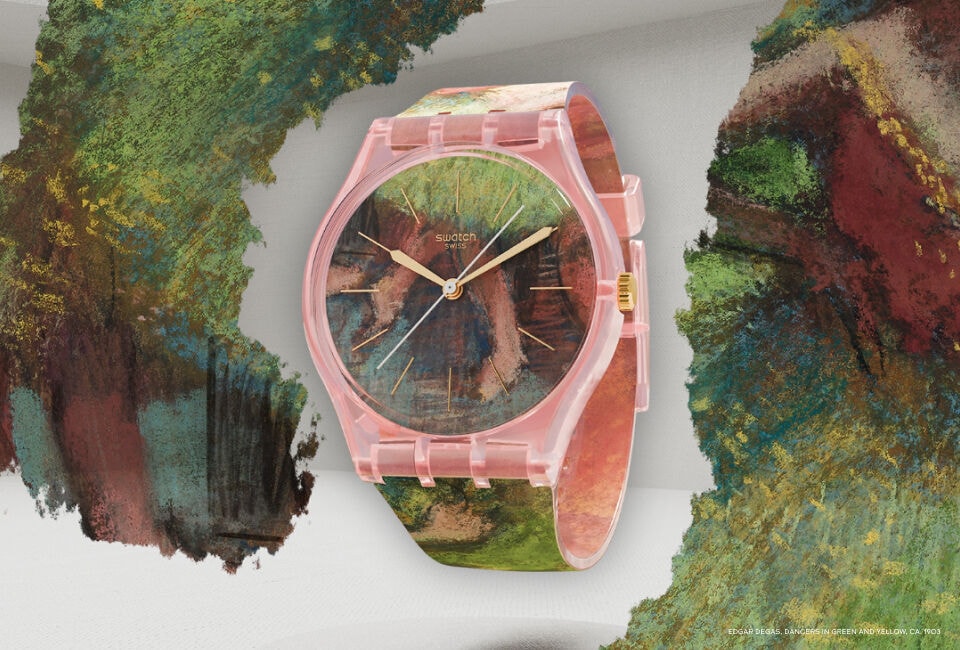
Let's delve into each watch, starting with the one inspired by Edgar Degas. The "Degas’s Dancers" model (reference SO29Z151) draws from Degas's pastel masterpiece Dancers in Green and Yellow (1903), housed at the Guggenheim in New York. Degas, a key figure in Impressionism, was obsessed with capturing movement, particularly in ballet scenes. This painting depicts ballerinas in mid-rehearsal, their tutus swirling in vibrant greens and yellows against a muted background. Swatch's interpretation crops the focus to the dancers' feet on the dial, emphasizing body language and grace, while the strap incorporates softer pastel washes. Crafted with a matte transparent silicone strap and BIOSOURCED case, it's water-resistant to 3 bar and priced at $105. This watch transforms Degas's fleeting moments into a daily reminder of elegance and discipline.
Next is "Monet’s Palazzo Ducale" (SO29Z150), inspired by Claude Monet's The Palazzo Ducale, Seen from San Giorgio Maggiore (1908), also from the New York Guggenheim. Monet, the father of Impressionism, painted this Venetian scene during his 1908 trip to Italy, capturing the Doge's Palace bathed in shimmering light across the lagoon. His loose brushstrokes and play of color evoke the ephemeral quality of light on water. Swatch replicates this on the dial with a panoramic view of the palace, using vibrant blues and pinks to mimic Monet's palette. The watch features a BIOSOURCED case and strap, with a printed loop adding a touch of the artist's signature. At $115, it's slightly higher priced, perhaps due to the intricate color reproduction, and offers the same 3-bar water resistance. Wearing this piece feels like carrying a slice of Venice's golden hour.

Paul Klee's influence shines in "Klee’s Bavarian Don Giovanni" (SO28Z703), based on The Bavarian Don Giovanni (1919) from the Guggenheim New York. Klee, a Swiss-German artist associated with Expressionism, Bauhaus, and Surrealism, created whimsical, abstract works blending color theory and childlike imagination. This painting, with its geometric forms and playful narrative inspired by Mozart's opera, features a figure in a Bavarian hat amid abstract elements. Swatch's design places the central motif on the dial, with the strap extending the colorful, mosaic-like patterns. Made from BIOSOURCED materials, it's priced at $105 and embodies Klee's belief in art as a form of visual music—perfect for those who appreciate subtle symbolism in their accessories.
Finally, "Pollock’s Alchemy" (SUOZ366) pays homage to Jackson Pollock's Alchemy (1947), from the Peggy Guggenheim Collection in Venice. Pollock, a pioneer of Abstract Expressionism, revolutionized painting with his drip technique, pouring and splattering paint to create chaotic yet harmonious compositions. This early drip painting, with its metallic silvers, blacks, and whites, represents Pollock's alchemical transformation of base materials into art. Swatch faithfully reproduces the poured-paint effect across the matte transparent case, dial, and strap, creating an all-over design that wraps around the wrist. At $115, it's a bold statement piece, water-resistant to 3 bar, and captures the energy of post-war American art.

These watches are not mere reproductions; they reinterpret the artworks through Swatch's lens of innovation. For instance, the use of BIOCERAMIC—a blend of two-thirds ceramic and one-third biosourced material—ensures durability and eco-friendliness, aligning with modern sustainability trends. The collection's packaging also nods to the museums, with special boxes featuring Guggenheim motifs. Available globally online at Swatch's official site and in physical stores since January 15, 2026, the pieces have already garnered attention for democratizing art. In a world where luxury watches can cost thousands, Swatch's affordable pricing invites a broader audience to engage with masterpieces that might otherwise remain distant.
The collaboration highlights a broader trend in the art world: museums partnering with consumer brands to extend their reach. The Guggenheim has previously collaborated with fashion houses like Louis Vuitton and tech companies for digital experiences. Swatch's history includes iconic artist editions, such as those with Keith Haring in the 1980s, which became collector's items. By choosing Degas, Monet, Klee, and Pollock, the collection spans Impressionism to Abstract Expressionism, offering a mini art history lesson on the wrist. Critics praise this accessibility, though some purists argue it risks commodifying art. However, as Stauffer emphasized, it "removes the distance" between people and cultural institutions, fostering appreciation in unexpected ways.
Edgar Degas (1834–1917) spent much of his career in Paris, focusing on themes of modern life, including theater and horse racing. His ballet series, comprising over 1,500 works, explored light, color, and human form, often from unconventional angles. Dancers in Green and Yellow exemplifies his mature style, using pastels for luminous effects. Claude Monet (1840–1926), based in Giverny, France, painted en plein air, capturing atmospheric changes. His Venice series, including The Palazzo Ducale, reflects his fascination with light's transformative power, influencing generations of artists.
Paul Klee (1879–1940) taught at the Bauhaus and experimented with abstraction, drawing from music and nature. The Bavarian Don Giovanni combines humor and geometry, referencing his Swiss roots and operatic interests. Jackson Pollock (1912–1956), working in New York, embodied the Action Painting movement. Alchemy, one of his first poured paintings, was acquired by Peggy Guggenheim, who championed him early on. Her Venice collection preserves this pivotal work, symbolizing the shift from European to American art dominance post-World War II.

In today's fast-paced world, where time is a luxury, these watches serve as reminders of timeless creativity. They appeal to art enthusiasts, fashion-forward individuals, and collectors alike. With Swatch's global network of over 3,000 stores and robust online presence, the collection is poised for success, potentially inspiring future collaborations. As art becomes more integrated into consumer culture—think NFTs or branded merchandise—this partnership exemplifies how institutions like the Guggenheim can evolve while staying true to their mission of education and preservation.
The Swatch x Guggenheim Collection isn't just about telling time; it's about timeless art. By wearing these pieces, one participates in a dialogue between past masters and present innovation, making every glance at the wrist a moment of inspiration.
FAQ
What artists are featured in the Swatch x Guggenheim Collection? The collection includes watches inspired by Edgar Degas, Claude Monet, Paul Klee, and Jackson Pollock.
How much do the watches cost? Prices range from $105 to $115, depending on the model.
Where can I buy the Swatch x Guggenheim watches? They are available online at the Swatch website and in Swatch stores worldwide since January 15, 2026.
What materials are used in these watches? The watches feature BIOSOURCED cases and straps, with some using BIOCERAMIC for durability.
Are these watches limited edition? The collection is not specified as limited, but as part of the ongoing Art Journey series, availability may vary.
How were the artworks selected for the collaboration? Selections were made in collaboration with Guggenheim curators, focusing on emotional impact and suitability for watch design.